Memory that knows when it's wrong.
Ingest scattered notes from ChatGPT, GitHub, PDFs, and more. Synapse actively reconciles conflicting facts, prunes unreinforced paths, and structures your personal knowledge graph.
Four steps to structured memory
From raw ingestion to confident recall, every piece of knowledge passes through the same pipeline.
Ingest Context
Connect scattered repositories, chat sessions, articles, and PDFs natively.
Reconcile Beliefs
Synapse detects conflicts at ingestion and surfaces them for quick resolution.
Recall Grounded
Run time-aware query diffs grounded dynamically on your metadata graph.
Decay Stale Nodes
Unreinforced memories fade over time and get pruned dynamically.
Your knowledge lives in twelve different places.
Decisions are made in ChatGPT. Framework specs are on GitHub. Research is stored in PDFs. Plain vector stores treat them as isolated strings. Synapse brings them together, structuring relationships dynamically.


Feed it anything. Structure is automatic.
Fetch
Ingests Raw context: PDFs, repository code, exports, or YouTube transcripts.
Extract
AI parsing identifies central semantic nodes, parameters, and entities.
remember()
Cognee maps relations, writing vectors and links directly into the database.
improve()
Synapse contradiction sweeps detect factual conflicts for human judgment.
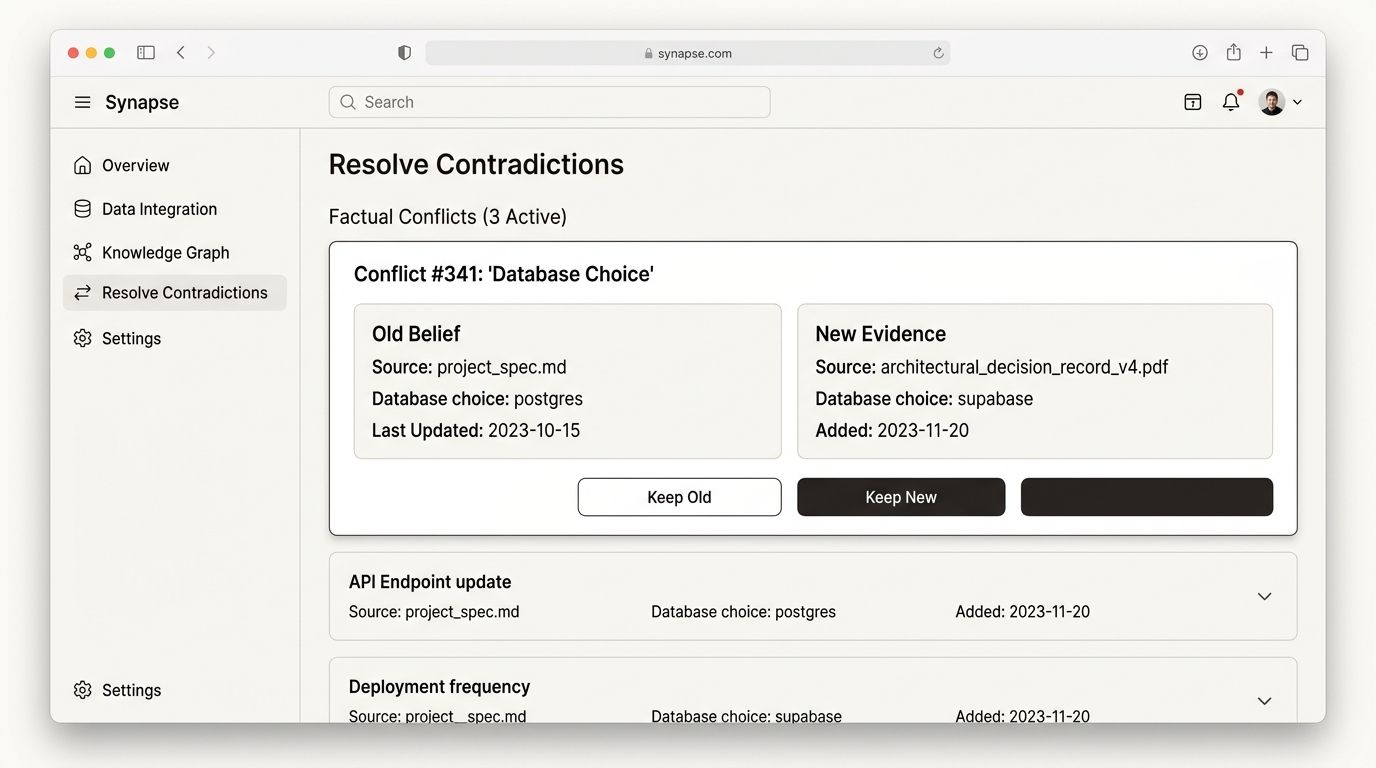
Conflicts resolved by design.
When new evidence contradicts an older belief, Synapse detects the contradiction at the schema layer and surfaces it immediately. You retain ultimate control over what enters your long-term memory graph.
"Authentication: basic client-side session checker."
auth_config.md"Authentication: Tier 1 shared-secret server proxy gate."
AGENTS.md
Unreinforced beliefs fade.
Confidence degrades proportionally over time. When a belief goes unreinforced, Synapse prunes it from the graph via cognee.forget().

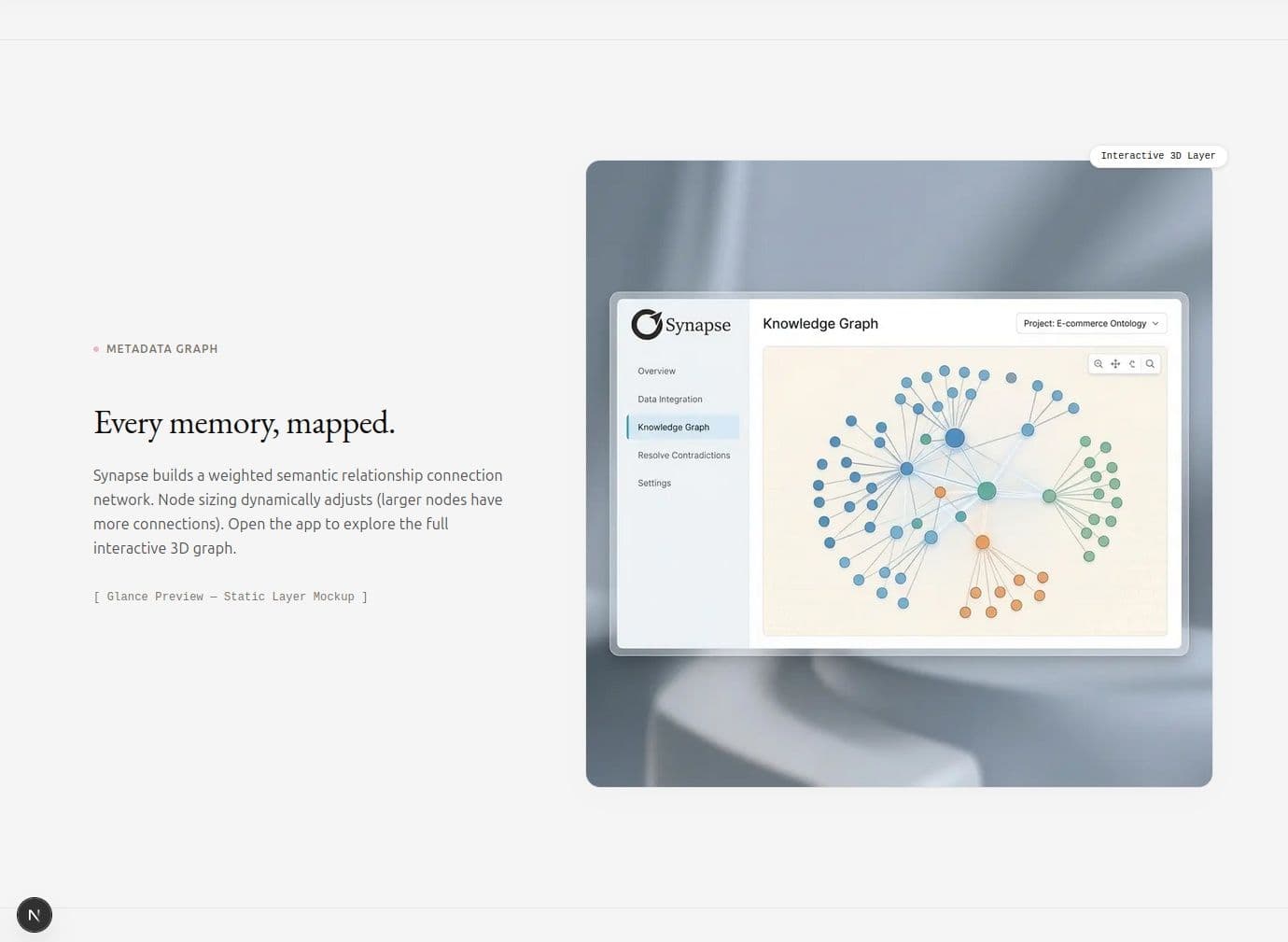
Every memory, mapped.
Synapse builds a weighted semantic relationship connection network. Node sizing dynamically adjusts (larger nodes have more connections). Open the app to explore the full interactive 3D graph.
See what your memory knows.
New tools that expose the inner structure of your graph: provenance traces, schema inventory, session distillation, and entity-level filtering.
Memory Provenance
Visualize the exact path each piece of knowledge took before entering your graph.
Schema Inventory
Browse all entity types in your graph with counts — classes, frameworks, patterns detected.
Session Distillation
Compress active-session context into structured guidance. No more re-explaining.
Graph Type Filtering
Filter the 3D graph by entity type to focus on specific knowledge domains.
Built on Cognee's memory lifecycle.
Engineered with advanced database structures and LLM layers to automate personal context curation.
5 Source Types
Ingests PDFs, GitHub repositories, ChatGPT conversational exports, YouTube transcripts, and web articles natively.
Reconciliation Engine
Validates every new belief against your graph in under 1.8 seconds using schema-level contradiction checks.
Time-Aware Decay
Confidence scores decay continuously (t1/2 = 30 days) and are automatically pruned via cognee.forget() when confidence drops below 0.15.
3D Knowledge Graph
WebGL force-directed visualizer mapping up to 5,000 nodes with real-time provenance tracing, zoom, pan, and direct node mutation.
Structured Diffs
Generates clean JSON diffs showing precise schema operations: remember(), improve(), and forget() with transaction histories.
Built-in MCP Server
Exposes graph queries (get_nodes, query_graph) directly to Cursor, Claude Desktop, or custom agents via standard JSON-RPC.
Frequently Asked Questions
Substantive answers to technical questions about Synapse's memory architecture.
Stop re-explaining context.
Build a memory graph that reconciles, decays, and actively maintains itself.